DC Generators | DC Brushless PM Motors | Induction Motors | Para Español, traducción de Julio Andrade.
Vehicle Alternators
- Advantages: cheap, easy to find, pre-assembled.
- Disadvantages: high rpms required, gears or pulleys needed, low power output, slip rings need maintenance.
- Suitability for Wind Power: POOR
A standard car or truck alternator is electromagnetic-- meaning that some of the electricity produced by the unit must be used internally and sent to the armature through brushes and slip rings to make the magnetic field. Alternators that use electricity to generate the field current are less efficient and more complicated. They are quite easy to regulate, however, since the magnetic flux inside can be changed by adjusting the field power.
Also, the brushes and slip rings wear out, requiring more maintenance. Car and truck alternators can also be rewound to produce power at lower speeds. This is done by replacing the existing stator windings with more turns of smaller gauge wire. This project is not for the faint of heart, but check our PRODUCTS page for the inexpensive booklet Alternator Secrets by Thomas Lindsay if you are interested. The booklet is invaluable for any alternator experimentor! Also, some alternator/electric motor shops may have the knowledge to do this for you.
Homemade Permanent Magnet Alternators
- Advantages: Low cost per watt of output, very efficient, huge power output possible, extremely sturdy construction
- Disadvantages: A time-consuming, somewhat complicated project, machining needed.
- Suitability for Wind Power: GOOD
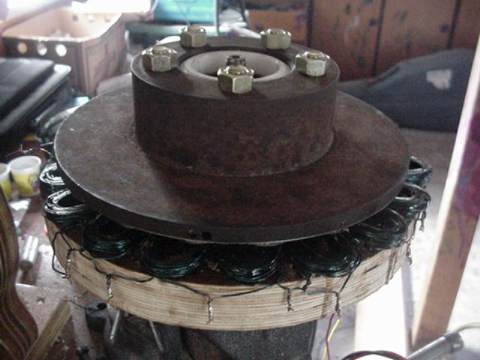
Homemade Volvo Brake Disc PM alternator, 800 watts, $150!
Hugh Piggott in Scotland was the pioneer in building permanent magnet alternators from scratch. Much of our inspiration came from his designs. Thanks Hugh!
Our experiments have consistantly shown that homemade PM alternators are the most powerful and cost-effective solution for building a wind generator. Their low-rpm performance is excellent, and at high speeds they can really crank out the amps thanks to their efficiency. Our more recent PM alternators have been based on Volvo disc brake assemblies, which are very sturdy and have thrust bearings built into the unit. Our larger units are "Disc" or "Axial" designs...a flat plate of magnets rotating next to a flat plate of coils. Our smaller PM alternators are "Radial" designs, where the magnets are fastened to the outside radius of the armature. Since all alternators produce AC, the output must be converted to DC with bridge rectifiers for battery charging.
Our designs to date have been single phase for ease of construction. Three-phase alternators have some advantages (they are somewhat more efficient, and make better use of available space), but they are somewhat more difficult to build.
With a 7 ft diameter prop, our Volvo brake designs can put more than 60 amps into a 12 volt battery in a 30-mph breeze--that's about 700 watts. We've seen the Volvo design peak at over 100 amps during high winds! This gives these homebrew designs a big advantage over similar-sized converted induction motors, which become inefficent quickly and top out at 20-25 amps output with a 7 ft. diameter prop.
Check out all of our PM alternator projects on our EXPERIMENTS page!Induction Motor Conversion Alternators
- Advantages: cheap, easy to find, fairly easy to convert, good low-rpm performance.
- Disadvantages: power output limited by internal resistance, inefficient at higher speeds, machining needed.
- Suitability for Wind Power: OK
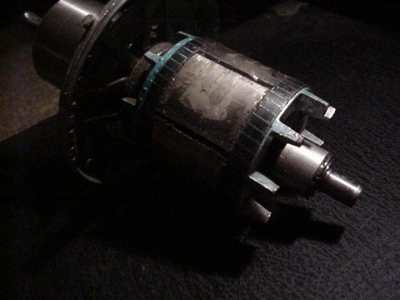
Armature converted with permanent magnets
A normal AC induction motor can be converted into a permanent magnet alternator at very low cost. Our experiments have shown that these conversions produce significant power at very low speeds, but become inefficient quickly at higher power levels.
An induction motor has a center core with no wires in it, just alternating plates of aluminum and steel (it will look smooth from the outside). If you rout a groove in this center core to accept permanent magnets, the unit becomes a permanent magnet alternator! We sell super-powerful neodymium magnets that are shaped and polarized perfectly for this application--check our products page.
In practice, our wind generators made with these do quite well until they reach 10-20 amps of output. At this point, they become inefficient quickly--it takes a large increase in windspeed to make only slightly more power, and the rest is wasted as heat inside the unit. The induction motors are wound with wire that's simply too thin for generating large amounts of power. In our tests, DanB's PM induction motor conversion windmill peaks at around 25 amps in 30 mph winds, with a 7-foot diameter prop. By comparison, a 7-foot prop on an efficient PM alternator made from scratch gives peaks of 50-60 amps in similar winds! Converted motors also have the tendancy to "cog" when starting...you can feel the resistance when you turn the shaft. This affects low-speed startup somewhat.
If the lesser output in high winds is acceptable to you, these units can make for a pretty easy wind generator project. Look for AC induction motors of the lowest rpm rating possible. 3-phase motors will perform better than single phase. Since alternators produce alternating current (AC), the power must be converted to DC with bridge rectifiers.
Tips and photos--converting an AC induction motor into a permanent magnet alternator.DC Generators
- Advantages: Simple and pre-assembled, some are good at low rpm.
- Disadvantages: High maintenance, most are not good at low rpm, large sizes very hard to find, small ones have limited power output.
- Suitability for Wind Power: POOR to OK
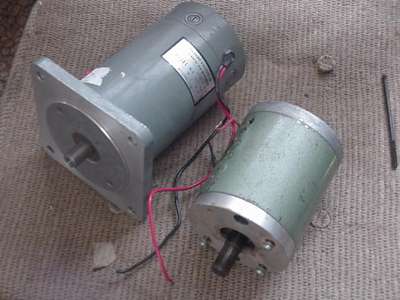
Surplus tape drive motors can make a quick and easy generator for small windmills
Brushless DC PM Servo Motors
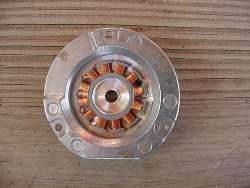
A brushless DC permanent magnet motor is really just a permanent magnet alternator! A special driver circuit provides AC power that is in phase with the rotation. If you are able to find a large one of these surplus, it's possible you might have an excellent start for a wind power project. They are used in robotics and precision control applications, and some use Nd-Fe-B magnets for high torque in a small space. As with surplus tape drive motors, we would not trust the bearings to stand up in a wind power application...add more bearings so you don't ruin the motor's original front bearing. We have not yet been able to locate any of these surplus for experimentation. If you have tried this, or have more information on sources, please Email us! However, we do have a small version...our Homemade anemometer uses a small surplus brushless DC PM motor, which is available for cheap on our Products pages.