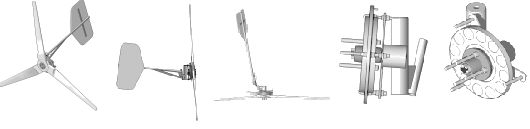
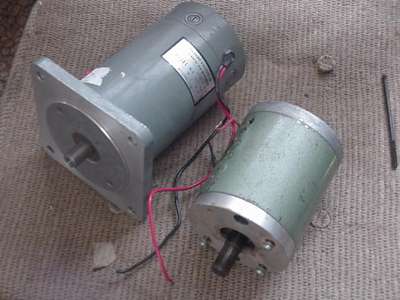
 These may well be the best, most inexpensive, ready to go low rpm DC generator out there. They are not ideal for wind and hydro power, but they are very convenient! Check out our Choosing an Alternator or Generator page for more details on their advantages and disadvantages. Expect a maximum of 200 watts from the larger versions (about 4 inches diameter by 8 inches long) and 100 watts from the smaller ones. They are surplus, from large mainframe computer tape drives. The supply seems to be getting scarce--we had a few in stock at one time--but they sold out quickly and we have not been able to obtain any more. They seem to come in many sizes, the larger ones usually having higher output. We've built and seen many very successful wind generators made from these, usually capable of 150 watts at best. They seem to be well built, have robust bearings and can hold up for years. The bearings are not really designed for a thrust load, so adding another bearing and shaft might be wise. They are DC motors, so they do have brushes which do wear out. Some of these will generate 12 volts at less than 300 rpm! Even simply shorting out the leads makes them difficult to turn by hand (a good sign for a low rpm generator). These generators have 4 ceramic grade permanant magnets in them. Maximum current before demagnetization occurs is 24 amps. Weight, 10 lbs. +/-.
Current Best Bets for obtaining these motors:
Ebay -- around $50, lots available
These may well be the best, most inexpensive, ready to go low rpm DC generator out there. They are not ideal for wind and hydro power, but they are very convenient! Check out our Choosing an Alternator or Generator page for more details on their advantages and disadvantages. Expect a maximum of 200 watts from the larger versions (about 4 inches diameter by 8 inches long) and 100 watts from the smaller ones. They are surplus, from large mainframe computer tape drives. The supply seems to be getting scarce--we had a few in stock at one time--but they sold out quickly and we have not been able to obtain any more. They seem to come in many sizes, the larger ones usually having higher output. We've built and seen many very successful wind generators made from these, usually capable of 150 watts at best. They seem to be well built, have robust bearings and can hold up for years. The bearings are not really designed for a thrust load, so adding another bearing and shaft might be wise. They are DC motors, so they do have brushes which do wear out. Some of these will generate 12 volts at less than 300 rpm! Even simply shorting out the leads makes them difficult to turn by hand (a good sign for a low rpm generator). These generators have 4 ceramic grade permanant magnets in them. Maximum current before demagnetization occurs is 24 amps. Weight, 10 lbs. +/-.
Current Best Bets for obtaining these motors:
Ebay -- around $50, lots availableC&H Sales -- around $60, available
Surplus Sales of Nebraska (no website)
Local electronics stores -- many small mom and pop electronics stores have a couple of these around.
Our experience....a windmill with one of these might need taken down once every two years to replace the ball bearings and brushes. One of our neighbors built a very simple hydro system, out of a squirrel cage fan and one of these. They are also well-suited for direct connection to a small pelton or turgo wheel for hydro power, a bicycle for human power, a circular wire cage for dog or cat power... In a battery-charging application, you will need a heat-sinked diode in the circuit, otherwise the battery will simply spin the motor. We sell 35-amp diodes on our products page. Our test results from these motors appear below. Please note that these tests were approximate--the lathe we used for testing them started to bog down at about 9 amps. In our experience using these for windmills, they can produce much more current than this. The voltages given are OPEN CIRCUIT, the amperages were measured while connected to a battery bank. As with any generator or alternator for battery charging, the battery bank will hold the generator's voltage down to its own level during charging, until the batteries fill. At that point, you need some sort of regulation that does not allow a wind generator or hydro plant to overspeed and 'freewheel' -- in other words, a load of some sort must be kept on the motor after the batteries fill. These motors are ideal for charging 12 volt battery banks!
| RPM | Large Motor Volts | Large Motor Amps | Small Motor Volts | Small Motor Amps |
| 80 | 3.0 | -- | 3.0 | -- |
| 130 | 5.1 | -- | 5.0 | -- |
| 200 | 8.0 | -- | 8.0 | -- |
| 340 | 13.5 | 2.0 | 13.4 | -- |
| 440 | 18.2 | 4.0 | 18.5 | 6.2 |
| 780 | 31.0 | 8.5 | 31.5 | 8.0 |
| 1260 | 48.3 | 12.0 | 50.5 | 9.0 |