Advances in solar photovoltaic panels are happening at a fast and furious rate. Plus, the newest panels should have an even longer life expectancy than the older models--older panels have started to turn brown in the clear substrate the solar cells are mounted in, reducing their power output. This problem has been solved by using new plastics 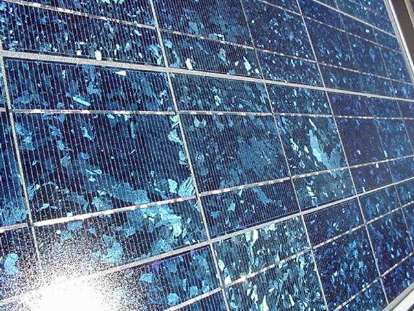 in the manufacturing process. The biggest advances in new solar panel technology recently have been in power density--the newest panels are the same size as older models, but put out more power per square foot.
A SOLAR POWER MYTH
We've often heard the myth that "it takes more electricity to manufacture a solar panel than it will ever put out." This is simply not true...this myth may have started during the Ronald Reagan era. This is of course a very difficult statistic to calculate, but according to the National Renewable Energy Laboratory in Golden, CO, a study has been done to answer the question. The study found that single-crystal panels reach the energy payback point in 5-10 years, polycrystalline panels in 3-5 years, and amorphous silicon panels in 0.5-2 years. Be advised that because the question is so vague, there is a large margin of error for these figures! We just discovered a recent, very detailed study about solar panel energy payback time in the January 2001 issue of Home Power magazine. This study, by Karl Knapp, PhD, and Teresa Jester, finds payback time for a standard module to be about 3.3 years, and 1.8 years on a thin-film panel. The study factors in energy costs for ALL parts of the panel and manufacturing process.NEW SOLAR PANEL DEVELOPMENTS OF INTEREST
- High voltage solar panels and arrays. Older panels usually made either 12 volts or 24 volts, and you'd use multiple panels in series for 48 volt home power systems. Now that 48 volt systems are the norm and 12 volt systems are becoming very rare, high-voltage panels are commonly available, running at 65 volts or more. The higher voltage results in a much more efficient array due to lower line losses. These panels can't be connected directly to a battery bank, they require a different type of controller:
- Maximum Power Point Tracking (MPPT) controllers. These new controllers can increase the output of any solar panel by 15-20 percent by trading volts for amps (and vice versa) to adjust the array output to changing conditions (clouds, snow on the ground, the angle of the sun). They also accept high voltage input directly, so we are frequently seeing 100-135 volt solar arrays. You then simply tell the MPPT controller what voltage your battery bank runs at, and it automatically adjusts your array. The results are greatly increased output on overcast days, and greatly increased output when the sun is not hitting the panels at an optimum angle. MPPT makes expensive mechanical trackers (below) less and less cost effective.
- Solar roof shingles. These inexpensive solar panels don't make as much power as their big brothers. But because of the price and simplicity of the rack used for mounting and wiring them, you can cover your entire roof with panels (or at least the south-facing part).
More information on designing a solar power system:
- The design, size and cost of a solar photovoltaic power system for your home depends on only a few simple factors:
- How much energy in kilowatt-hours (kwh) do you use per month, and how much does it cost you?
- What can you do to reduce your energy usage, and how much will that cost you? (Every dollar spent on conservation will save you $3-$5 on the cost of an RE power system).
- What solar resource do you have available at your location?
- Renewable Energy Basics -- This article guides you through answering ALL those questions above, in great detail. Includes information on grid-tied, off-grid and grid tie with battery bank systems.
TRACKING THE SUN
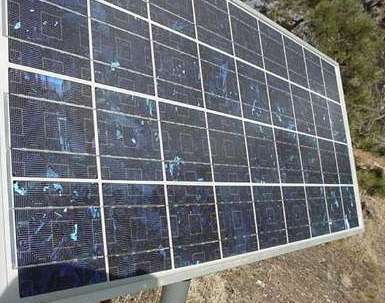
Many different varieties of tracking solar panel mounts are available. One-axis trackers stay at the same vertical angle, but rotate around the post to follow the sun from sunrise to sunset. The vertical angle is set manually to match the angle of the sun for the current season--closer to flat for summertime, and at a steep angle for winter, with the exact angle dependant on your lattitude. The rule of thumb is to set the panels at your latitude minus 15 in summer, and latitude plus 15 in the winter. Dual axis trackers also adjust the vertical angle automatically.Advantages of trackers:
- Your solar array is almost always facing the sun at exactly the optimum angle, for best power output.
- The closer you are to the equator, the more gains a tracker will give you.
- For many water pumping applications trackers are recommended, especially if the system does not shut down when a water tank is full, etc.
- Can decrease payback time of a grid-tied system.
Disadvantages of trackers:
- They are a mechanical device with moving parts that need regular maintenance and that can fail.
- Trackers can be affected by high winds, causing them to point in the wrong direction on windy days.
- They give you the most gain in power during summer, when you are less likely to need the extra.
- MPPT controllers (above) give almost as much energy gain as trackers, but do it with no moving parts and at a MUCH lower cost.
- High cost--the expense of installing a pole mount and of the tracker itself is prohibitive. You could buy 1-2 extra solar panels for the same cost as a tracker.
Our opinion:
- Very few people in our community use trackers. We are located high in the moutains, and extremely high winds are commonplace. We often observe those few trackers that are installed around here pointing in exactly the wrong direction on windy days, making little or no power. And here at 40 deg N latitude, the summer gain from a tracker is not really needed--it's winter when we need extra power, and trackers don't help much because of the narrow arc of the sun during winter months. And now that most larger power systems up here have new MPPT controllers installed, the gains from a tracker are made even less.